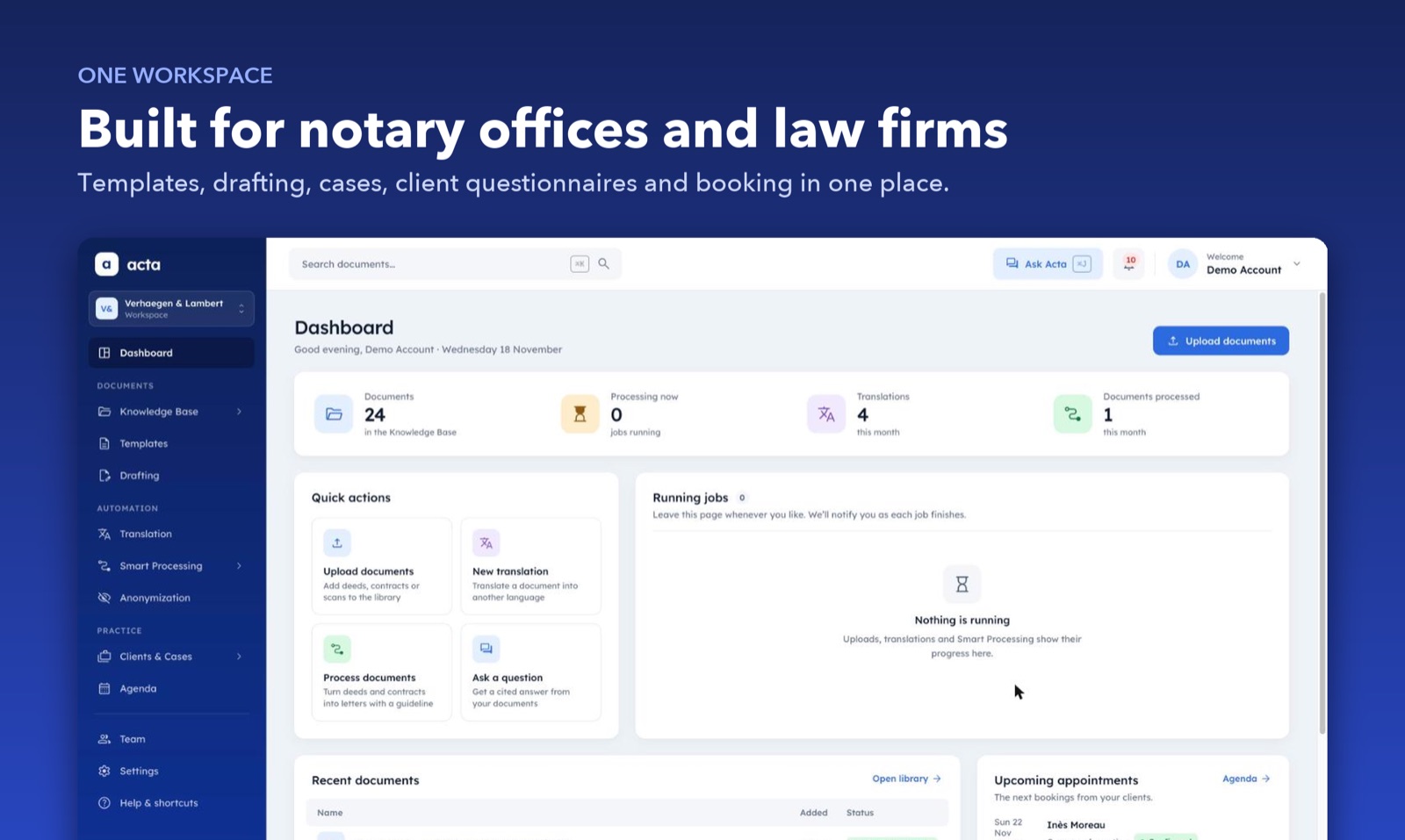
Acta is a web app for notary offices, lawyers and law firms. It answers questions from the office's own documents and shows the page each answer comes from, fills the office's own Word templates, translates while keeping the layout and anonymizes documents. A person always checks the result. I built it because offices lose hours every week on the same document tasks.
I'm Ala Baganne, a software engineer, and I design and build Acta myself. This post explains what Acta is, why it exists and how I work on it with the offices that use it.
What is Acta?
Acta is a workspace for an office's documents. You upload your files once: deeds, contracts, letters, scans, emails, spreadsheets. Acta reads them, and then helps with the work around them.
Each office has its own workspace. Everyone in the office sees the same documents and the same cases. The data is private to that workspace.
The interface is in English, French and German. Acta runs on a server in Germany and uses OpenAI's models.
What problem does it solve?
Talk to anyone in a notary office or a law firm and you hear the same list:
- Finding a fact in a long file. A clause, a date, a plot number, a name. It is in there somewhere, on page 37 or in an email from last spring.
- Typing the same facts again. The names, addresses and amounts from a compromis go into a deed, then into a letter, then into another letter.
- Writing the same kind of letter again. The office has sent a hundred letters like it. Each one is still written by hand.
- Translating for a foreign client. The text is easy to send to a translation site. The layout is not, and fixing it takes longer than the translation.
- Removing names before sharing. Black boxes over a PDF, page by page, and the worry that one was missed.
None of this is legal work. It is the work around legal work. And it takes a large part of the week.
Why not just use ChatGPT?
A general chatbot is good at generic text. It is not built around an office's files.
It has never seen your deed unless you paste it in. Its answers come without a page, so you must find the source yourself. Each person has their own chats, so the office has no shared view. It does not fill your Word template with your layout. And client data ends up in personal accounts.
I wrote a longer, fair comparison in ChatGPT vs legal AI. The short version: the model is not the hard part. The workspace around it is.
What does Acta do today?
- Ask Acta. Ask a question about your documents and get an answer with the exact page it comes from. One click opens that page.
- Drafting. Fill your own Word templates. Acta can propose the values from a case, a note or a document, and shows where each one comes from.
- Smart Processing. Show Acta a few examples of a document before and after your office worked on it. It learns the steps and writes new ones in the same look.
- Translation. Translate PDFs, Word files, slides, sheets and scans into 12 languages, keeping the layout close to the original.
- Anonymization. Find and hide personal data, then review what was removed before you share the copy.
- Clients & Cases. Keep documents, drafts and appointments under the case they belong to.
- Agenda. Let clients book an appointment from a link, with emails and reminders sent for you.
What principles guide it?
A person checks. Acta proposes. The notary or lawyer reads, corrects and signs. That is why answers show their source: so the check takes seconds, not minutes.
The office's data stays the office's. Each workspace is private to its members. Owners and admins can export everything, and the owner can delete the workspace.
Honest limits. Acta is hosted, not installed on your own server. It uses OpenAI's models. It does not connect to other office software yet. I would rather say this plainly than have you find out later.
How is Acta built?
With the offices that use it. Acta is in a pilot, and it is free during the pilot. I watch how people work, read every piece of feedback and change the app every week.
Most of what Acta does today started as a sentence from someone in an office: "I spend my mornings on this." The next features will come the same way. I don't promise a roadmap. I promise to listen.
What comes next?
More of the routine work, done well. Better results on the files offices really have: old scans, mixed languages, long deeds. And a smoother start for a new office on day one.
How can I try it?
The quickest way is to tell me which tasks take your office the most time. I'll show you Acta on that kind of file. Request a demo, or first watch the demo video to see one deed of sale go through the app.
Written by Ala Baganne, software engineer and founder of Acta.
About the authorSee what Acta can do for your office
Tell me which tasks take your office the most time, and I’ll tailor a free demo to them.
Request a demo